Architectural Approaches: All-in-One vs. Modular
The consumer weather station market generally bifurcates into two hardware architectures: monolithic (all-in-one) sensor suites and discrete, modular arrays. Understanding the mechanical constraints of each is fundamental to acquiring accurate localized climate data.
All-in-one units consolidate the anemometer, rain gauge, temperature, and humidity sensors into a single plastic housing. The primary advantage here is rapid deployment. Users mount a single pole, align a solar panel South (or North, depending on hemisphere), and begin receiving telemetry. However, this architecture violates core meteorological siting guidelines. Accurate wind measurement requires an elevated placement, while accurate temperature and precipitation measurement demands a lower placement away from structural heat sinks.
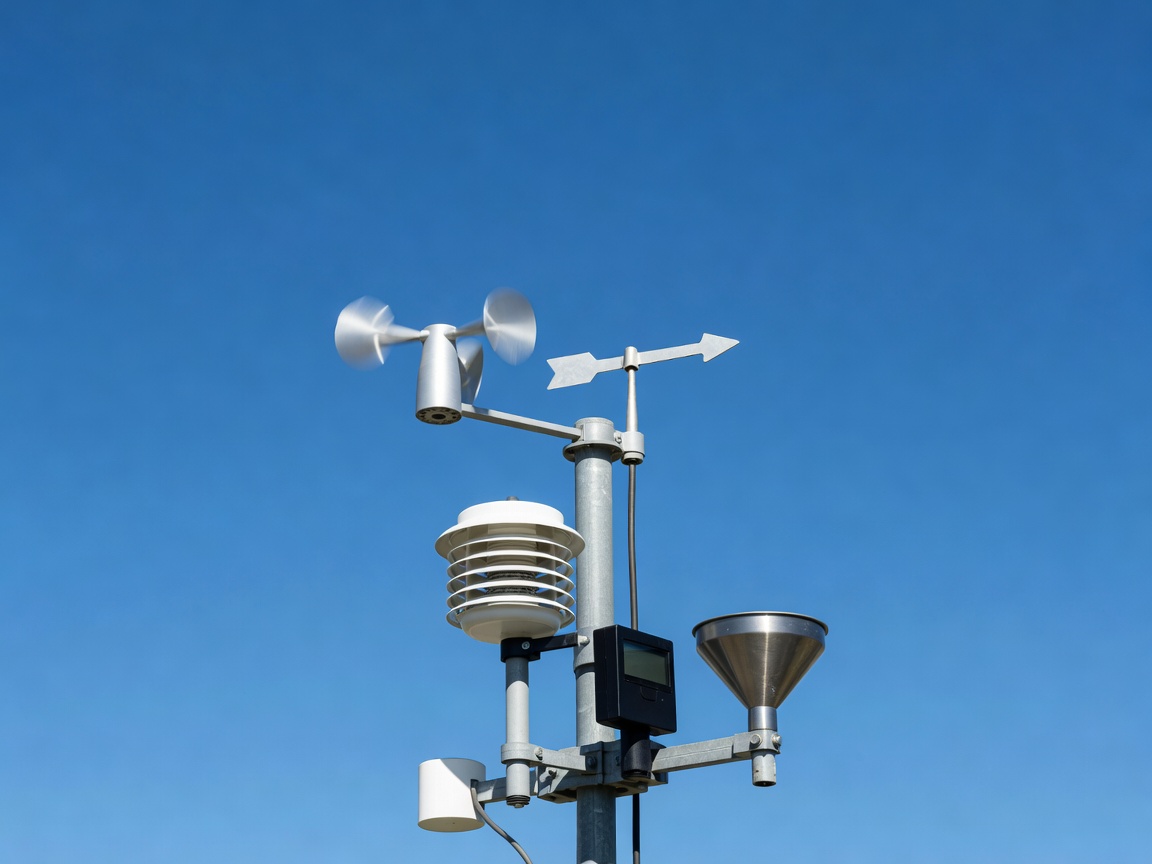
Modular stations divorce the anemometer from the thermo-hygrometer and rain gauge. This permits the user to place the anemometer on a rooftop mast, where wind flow is laminar, while siting the temperature gauge roughly five feet above natural ground cover, shielded by an aspirated radiation shield. While cabling and multiple transmission nodes increase the installation complexity, the resulting data fidelity is significantly higher.
Wireless Transmission Protocols
Data transmission between the outdoor sensor suite and the indoor console (or gateway) determines system reliability. Most consumer-grade hardware relies on Sub-1 GHz RF bands—commonly 433 MHz, 868 MHz (in Europe), or 915 MHz (in North America).
Sub-1 GHz frequencies offer superior wall penetration and distance metrics compared to 2.4 GHz Wi-Fi. A standard 915 MHz system will often boast a line-of-sight range of 1,000 feet (300 meters). However, practical deployment across residential architecture—penetrating stucco, low-E glass, and insulated walls—typically reduces effective operational range to roughly 150 to 300 feet. When assessing hardware specifications, one must account for RF interference from nearby devices operating on identical industrial, scientific, and medical (ISM) radio bands.
Spread-spectrum frequency hopping is utilized in higher-tier stations to guarantee data packet delivery in noisy RF environments. If a transmission fails on one channel, the transmitter and receiver shift in tandem to an alternate frequency.
Power Infrastructure and Longevity
Sustained operation of outdoor telemetry equipment requires robust power management. The industry standard utilizes a primary solar panel array charging a supercapacitor, backed up by non-rechargeable lithium batteries (such as Lithium Iron Disulfide).
Standard alkaline batteries are heavily discouraged in meteorological equipment. Alkaline cell voltage drops precipitously in freezing conditions, leading to data transmission dropouts precisely when winter weather tracking is most critical. Lithium cells maintain a stable discharge curve down to -40°C.
For modular components placed in permanent shade (such as a properly sited temperature sensor beneath a dense tree canopy), the system must rely entirely on internal battery life. High-frequency update intervals—such as transmitting wind data every 2.5 seconds—dramatically reduce battery longevity unless managed by an efficient microcontroller state machine that enforces deep sleep cycles between packet bursts.
Aspirated Radiation Shields
The most common error in amateur meteorological data is temperature over-reporting due to solar loading. When sunlight strikes the plastic housing of a thermo-hygrometer, internal temperatures can exceed ambient air temperatures by several degrees.
Passive radiation shields utilize stacked, angled louvers to reflect direct solar radiation while allowing ambient air to flow over the sensor. However, in calm wind conditions, air can stagnate inside the shield. Active (fan-aspirated) radiation shields solve this by employing a small, solar-powered fan to draw ambient air over the sensor element at a constant velocity, ensuring precise thermal readings regardless of solar intensity or wind speed.
Siting and Deployment Strategy
Acquiring a high-tier station is irrelevant if it is mounted improperly. Best practices dictate:
- Temperature/Humidity: Placed 4–6 feet above a natural surface (grass or soil), at least 50 feet from paved surfaces to avoid thermal retention.
- Rain Gauge: Placed in an open area. The distance to the nearest obstacle (like a tree or building) should be at least two to four times the height of the obstacle to prevent wind shadowing and rain deflection.
- Anemometer: Ideally 33 feet (10 meters) above the ground, clearing the nearest roofline by at least 7 feet.
Compromises are inevitable in residential plots, but prioritizing separation from artificial heat sources and wind deflectors will drastically improve the validity of historical data logs.